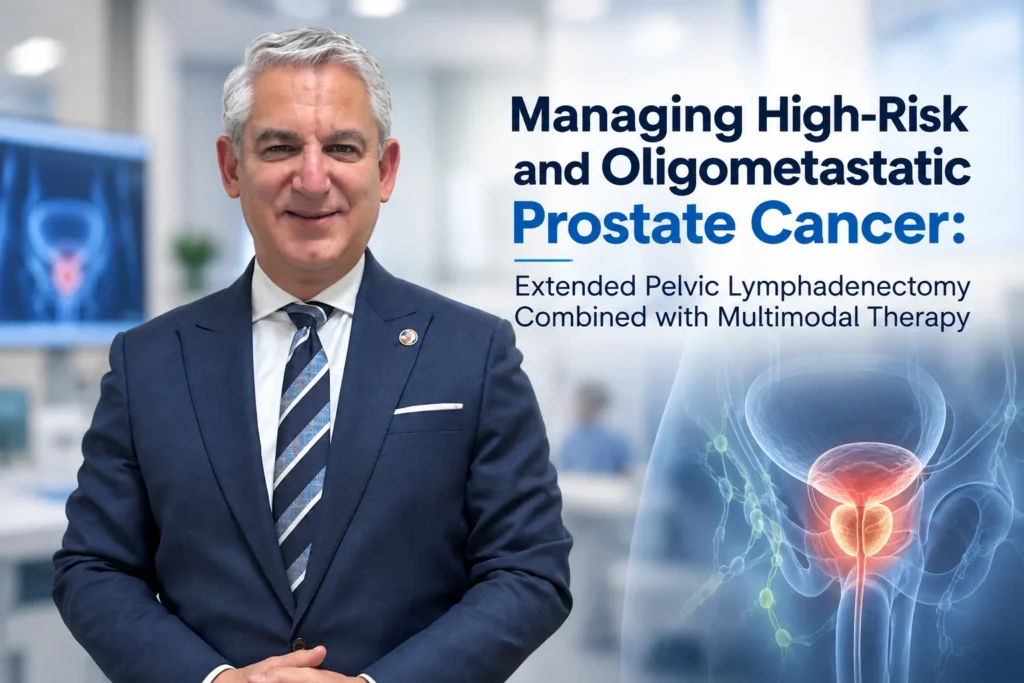
For decades, high-risk localized and oligometastatic prostate cancer were considered beyond the scope of primary surgical intervention. Patients presenting with high serum prostate-specific antigen or limited nodal/distant metastases were traditionally steered exclusively toward systemic androgen deprivation therapy (ADT) and definitive radiation. Surgery was often avoided due to assumptions of systemic futility, anticipated positive surgical margins, and the technical complexity of dissecting inflamed, locally invasive tissue planes.
However, clinical trials and large-scale registry data have reshaped this management philosophy. Cytoreductive radical prostatectomy combined with an Extended Pelvic Lymph Node Dissection (ePLND) is now recognized as a key component of a comprehensive multimodal treatment strategy. By excising the primary tumor bulk, surgery eliminates the primary source of metastatic seeding, debulks regional lymphatic micrometastases, reduces the likelihood of future painful local complications (such as bladder outlet obstruction, intractable hematuria, and ureteral obstruction), and provides precise tissue staging that guides tailored systemic and radiation therapies.
Dr. David B. Samadi has long been an advocate for surgical intervention in advanced and aggressive disease. By adapting the SMART (Samadi Modified Advanced Robotic Technique) protocol for high-risk anatomy and combining it with meticulous, template-based extended pelvic lymphadenectomy, Dr. Samadi provides high-risk and oligometastatic patients with an operative foundation designed to optimize cancer control within a modern multimodal framework.
Redefining the Aggressive Disease Spectrum
High-risk and oligometastatic prostate cancer encompasses a distinct biological and anatomical spectrum:
[HIGH-RISK & OLIGOMETASTATIC SPECTRUM]
│
├─► 1. High-Risk Localized (D’Amico / EAU / NCCN Criteria)
│ └─► PSA > 20 ng/mL, Gleason 8–10 (ISUP 4/5), or clinical stage ≥ cT2c/cT3a
│
├─► 2. Locally Advanced (cT3b / cT4)
│ └─► Direct invasion into seminal vesicles, bladder neck, or pelvic sidewall
│
├─► 3. Regional Nodal Disease (cN1)
│ └─► Pelvic lymph node metastases identified on cross-sectional or PSMA imaging
│
└─► 4. Oligometastatic Prostate Cancer (M1a / M1b)
└─► Limited low-volume systemic spread (≤ 3–5 bone or extrapelvic nodal sites)
In oligometastatic presentations, the primary prostatic tumor acts not merely as a passive marker of disease, but as an active biological engine—seeding clonal variants, secreting pro-angiogenic cytokines, and driving systemic metastasis. Removing this primary lesion disrupts this metastatic cascade.
The Critical Role of Extended Pelvic Lymph Node Dissection (ePLND)
Lymph node status is one of the most reliable prognostic factors in prostate cancer. However, standard limited lymph node dissections (often restricted to the obturator fossa alone) miss up to 50% of nodal metastases, which frequently travel first to the hypogastric or common iliac chains.
Dr. David Samadi executes an Extended Pelvic Lymphadenectomy (ePLND) adhering to strict anatomical boundaries:
[EXTENDED PELVIC LYMPHADENECTOMY (ePLND) TEMPLATE]
│
┌────────────────────────────────────┼────────────────────────────────────┐
▼ ▼ ▼
[COMMON ILIAC CHAIN] [EXTERNAL ILIAC CHAIN] [INTERNAL ILIAC / OBTURATOR]
──► Proximal to aortic ──► Distal to circumflex ──► Internal iliac (hypogastric)
bifurcation / crossing iliac vein artery branches
of the ureter ──► Lateral to psoas muscle ──► Complete clearance of
obturator fossa around nerve
[Upper Limit] ──► Aortic bifurcation / Ureteral crossing point
[Lateral Limit] ──► Genitofemoral nerve along the psoas muscle
[Medial Limit] ──► Bladder wall, visceral pelvic fascia, and internal iliac branches
[Distal Limit] ──► Deep circumflex iliac vein and Cooper’s ligament (Femoral canal entrance)
[Floor] ──► Obturator nerve, internal obturator vessels, and pelvic sidewall
Therapeutic and Diagnostic Value of ePLND:
- Accurate Staging: Standard CT and MRI scans have high false-negative rates for micro-metastatic nodal disease. Pathologic inspection of 15 to 30+ retrieved lymph nodes identifies microscopic metastases early.
- Direct Cytoreduction: In patients with low-volume microscopic nodal metastases ($pN1$), complete surgical extirpation alone can lead to durable progression-free survival in a notable subset of cases without immediate systemic progression.
- Targeting Postoperative Radiation: Identifying the exact nodal packets harboring cancer allows radiation oncologists to customize postoperative fields, delivering targeted stereotactic boosts rather than generalized, unguided pelvic radiation.
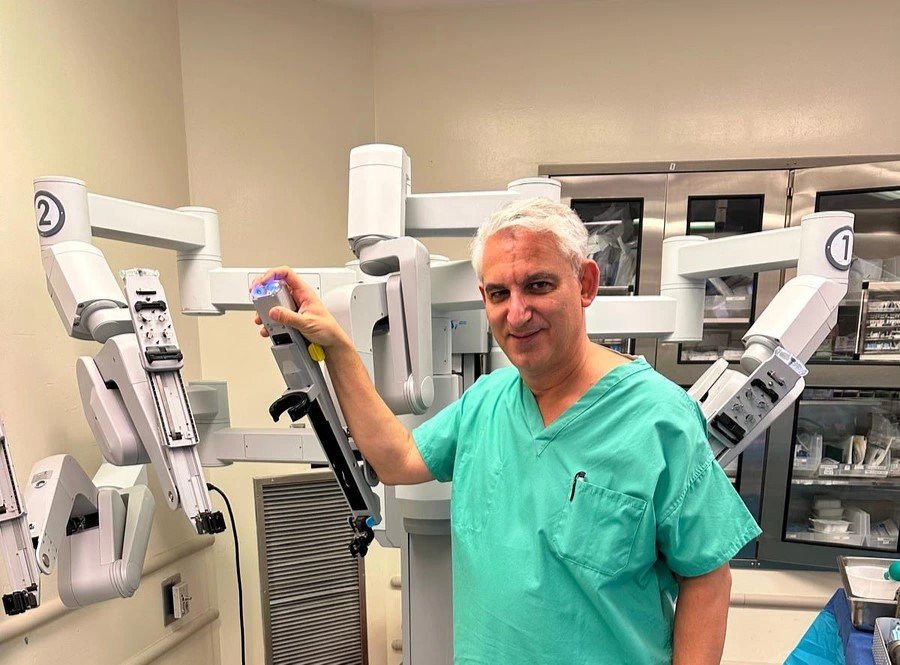
Technical Adaptations of the SMART Protocol for High-Risk Disease
Operating on high-risk, locally invasive tumors requires modifying surgical priorities. While functional outcomes remain critical, oncologic clearance is paramount:
[HIGH-RISK SURGICAL PROTOCOL]
│
├─► 1. Preoperative Multiparametric MRI & PSMA-PET Fusion Mapping
│ └─► Identifies precise areas of capsular breach, neurovascular abutment, and nodal targets
│
├─► 2. Intentional Wide-Excision / Non-Nerve-Sparing Resection (Tumor Side)
│ └─► Resects Denonvilliers’ fascia & neurovascular bundle en bloc if invasion is suspected
│
├─► 3. Contralateral Athermal Nerve Sparing (When Appropriate)
│ └─► If tumor is strictly unilateral, preserves contralateral bundle to maintain baseline function
│
└─► 4. Frozen Section Analysis of Questionable Surgical Margins
└─► Intraoperative evaluation of bladder neck, apical soft tissue, and neurovascular margins
- Managing the Prostatic Apex: In bulky, high-grade tumors, the apex is dissected with extreme precision. Dr. Samadi utilizes cold micro-shears without thermal cautery to expose the contour of the apical margin, obtaining negative margins while preserving functional membranous urethral length to protect future urinary control.
- Seminal Vesicle and Bladder Neck Management: When tumors invade the seminal vesicles (stage cT3b) or abut the bladder base, wide en bloc resection of the seminal vesicle tips and a modest bladder neck reconstruction are performed to avoid leaving residual malignant tissue behind.
Multimodal Sequencing: Surgery as the Backbone of Systemic Control
In high-risk and oligometastatic settings, surgery is rarely an isolated monotherapy. Instead, it serves as the foundation of a coordinated multimodal treatment protocol:
[RADICAL PROSTATECTOMY + ePLND] ──► Definitive Histopathologic Staging (Pathologic TNM, Margins, Nodes)
│
┌─────────────────────────────────┴─────────────────────────────────┐
▼ ▼
[UNDETECTABLE PSA (< 0.05 ng/mL)] [PERSISTENT PSA OR ADVERSE PATHOLOGY]
(Node-negative, negative margins) (pT3b, positive margins, or pN1)
│ │
▼ ▼
[Close PSA Surveillance] [Targeted Adjuvant / Early Salvage Therapy]
(Serial ultrasensitive PSA ├─► Modern Androgen Receptor Pathway
checks every 3 months) │ Inhibitors (ARPI: Enzalutamide/Apalutamide)
├─► Short-to-long term LHRH Agonist/Antagonist
└─► Image-Guided Intensity-Modulated Radiotherapy
(IG-IMRT) directed to bed & nodal stations
- Systemic Debulking: Removing the primary tumor reduces the circulating tumor burden and eliminates source populations of treatment-resistant cancer cells.
- Early Salvage vs. Adjuvant Radiotherapy: If histopathology demonstrates positive surgical margins, seminal vesicle invasion ($pT3b$), or regional nodal disease ($pN1$), modern practice favors early salvage or adjuvant radiotherapy targeted to the prostatic bed and pelvic nodal chains, often combined with temporary androgen deprivation therapy (ADT).
- Metastasis-Directed Therapy (MDT): In true oligometastatic disease (1 to 5 distant lesions), radical prostatectomy and ePLND are paired with Stereotactic Body Radiation Therapy (SBRT) directed at the distant metastatic sites, delaying or minimizing the duration of continuous systemic hormonal therapy.
Comparative Overview: High-Risk Treatment Pathways
| Clinical Feature | Systemic ADT + Radiation Alone | Radical Prostatectomy + ePLND as Part of Multimodal Care |
| Local Tumor Status | Primary tumor left in place (in situ) | Primary tumor bulk completely excised |
| Pathologic Staging | Clinical guess (CT/MRI/biopsy estimate) | Definitive histopathologic grade, stage, and nodal map |
| Nodal Clearance | Radiation to generic pelvic fields | Microsurgical removal of 15–30+ anatomical nodes |
| Future Local Complications | Higher risk of late obstruction, bleeding, or pain | Eliminates local symptomatic bladder outlet failure |
| Salvage Options | Salvage surgery after full-dose radiation is high-risk | Full secondary radiation options remain entirely available |
| Long-Term Systemic Burden | Often lifelong continuous ADT dependency | Allows for intermittent or delayed systemic therapies |
Mitigating Surgical Morbidity in Advanced Disease
Performing radical prostatectomy in high-risk patients demands meticulous technical execution to prevent complications:
- Lymphocele Prevention: The comprehensive clearing of lymphatic channels during an ePLND increases the theoretical risk of lymphocele formation. Dr. Samadi utilizes precise titanium clipping or bipolar sealing of incoming afferent lymphatic vessels and maintains retroperitoneal peritoneal windows to allow ongoing lymphatic fluid reabsorption.
- Preserving Pelvic Innervation: Care is taken to identify and preserve the obturator nerve along the pelvic sidewall during deep nodal dissection, preventing postoperative adductor muscle weakness.
- Protecting Continence Mechanisms: Even when nerve bundles must be resected for oncologic safety, meticulous preservation of the puboprostatic ligaments, dynamic pelvic suspension, and intrinsic urethral sphincter helps maintain early urinary continence.
Conclusion
High-risk and oligometastatic prostate cancer no longer represents an automatic contraindication to surgical treatment. When integrated into a modern, multimodal strategy, robotic radical prostatectomy combined with extended pelvic lymphadenectomy provides reliable local tumor debulking, accurate pathologic staging, and an improved foundation for long-term survival. Through high-volume expertise and meticulous anatomical dissection, Dr. David B. Samadi delivers advanced surgical oncology tailored to patients facing complex, aggressive prostate cancer.
- Surgeon: Dr. David B. Samadi, MD
- Specialization: Robotic Urologic Oncology, Advanced Prostate Cancer Surgery, Minimally Invasive Urology
- Key Innovations: Developer of the SMART (Samadi Modified Advanced Robotic Technique) Protocol
- Clinical Focus: High-Risk Prostate Cancer, Extended Pelvic Lymphadenectomy, Salvage Robotic Prostatectomy, Complex Pelvic Reconstruction
 212-365-5000