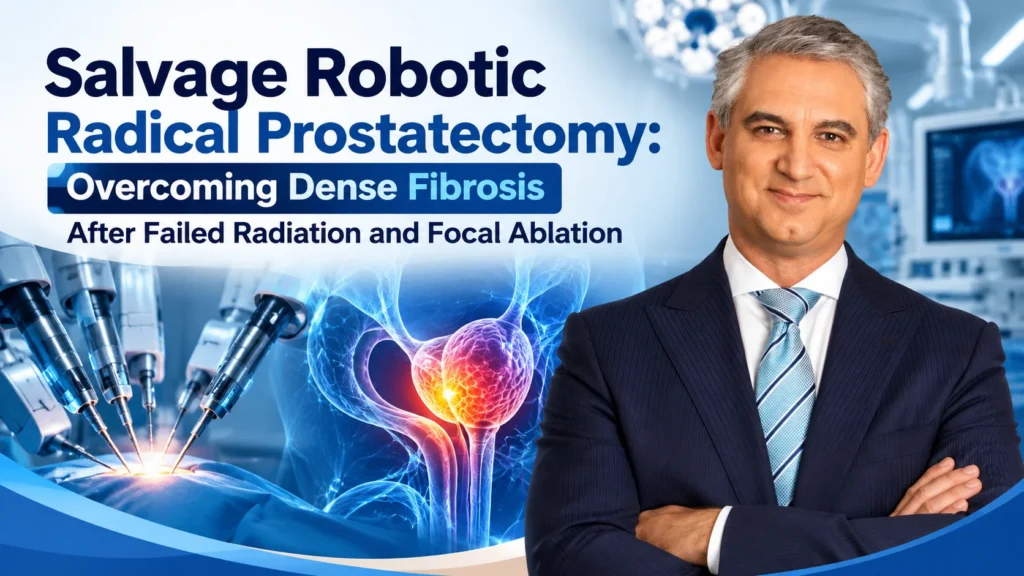
Primary radiation therapy—including external beam radiation therapy (EBRT), stereotactic body radiation therapy (SBRT), proton beam therapy, and brachytherapy (radioactive seed implants)—along with minimally invasive focal ablation (such as high-intensity focused ultrasound [HIFU] and cryotherapy) are widely utilized as primary treatments for localized prostate cancer. For many men, these non-extirpative modalities offer disease control. However, up to 20% to 30% of irradiated patients and an expanding cohort of focal ablation patients eventually experience local biochemical recurrence (a persistently rising PSA) within five to ten years of primary therapy.
When localized prostate cancer recurs after radiation or ablation, patients frequently feel their curative options are exhausted. Traditionally, secondary management defaulted to lifelong, non-curative androgen deprivation therapy (ADT), which carries long-term cardiovascular, metabolic, and bone-density side effects without eliminating the persistent, radioresistant cancer nidus.
In this challenging clinical scenario, Salvage Robotic Radical Prostatectomy (SRRP) provides a definitive secondary line of curative defense. However, operating in a previously irradiated or ablated pelvis is technically demanding. Ionizing radiation and thermal energy obliterate natural embryonic tissue planes, induce endarteritis obliterans, and encase the prostate, rectum, and neurovascular structures in dense, avascular scar tissue—often termed a “frozen pelvis”.
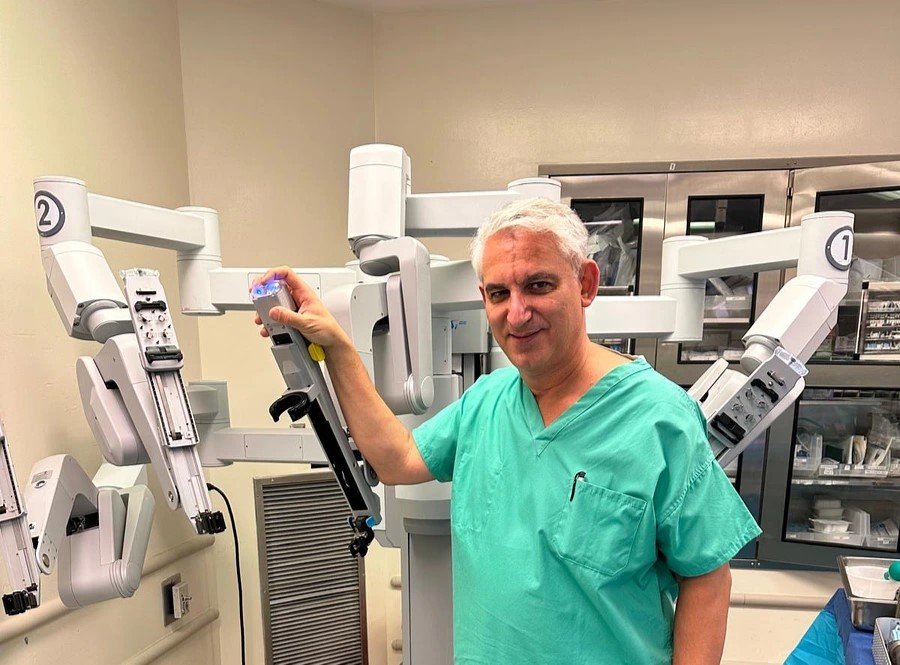
Dr. David B. Samadi has established advanced robotic protocols for these salvage procedures. Integrating his training in open radical surgery, traditional laparoscopy, and robotic platforms, Dr. Samadi adapts the SMART (Samadi Modified Advanced Robotic Technique) protocol to salvage cases. Utilizing athermal micro-dissection, clipless vascular management, and meticulous rectoprostatic preservation, Dr. Samadi removes the radioresistant gland while minimizing surgical complications.
The Hostile Anatomical Environment: The Biology of Post-Radiation Fibrosis
Operating on an untreated, virgin prostate gland involves dissecting through clear, pliable fascial boundaries. In contrast, salvage prostatectomy requires navigating an altered surgical landscape:
[PRIMARY RADIATION / FOCAL ABLATION]
│
▼
[MICROVASCULAR ENDARTERITIS OBLITERANS]
(Capillaries thrombose; micro-vessel walls thicken, severely starving local tissue of oxygen)
│
▼
[CHRONIC HYPOXIA & FIBROBLAST PROLIFERATION]
(Massive collagen cross-linking replaces pliable cellular matrices with leathery scar tissue)
│
▼
[OBLITERATION OF NATURAL FASCIAL PLANES]
(Denonvilliers’ fascia welds the posterior prostatic capsule directly to the rectal wall)
│
▼
[POOR MICROVASCULAR HEALING POTENTIAL]
(Vesicourethral anastomotic tissues lack robust blood perfusion, elevating risk of leaks and strictures)
- Loss of Denonvilliers’ Fascia: Radiation and thermal ablation dissolve the protective fatty tissue and distinct double-layered sheets of Denonvilliers’ fascia. The posterior prostate becomes densely adherent to the anterior rectal wall, increasing the baseline risk of rectal perforation if approached without precision.
- Poor Tissue Perfusion: Endarteritis obliterans reduces capillary micro-circulation. Tissues do not bleed normally—they exhibit poor tissue compliance, tear easily, and heal slowly, elevating the historical risk of anastomotic strictures and urinary leaks.
- Apical and Sphincteric Scarring: The membranous urethra and intrinsic striated urethral sphincter are often caught in dense apical fibrosis, obscuring the boundary between the apex of the prostate and the urinary sphincter mechanism.
Preoperative Salvage Workup and Patient Restratification
A salvage robotic prostatectomy should only be undertaken after confirming that the cancer recurrence is strictly confined to the prostate gland:
[RISING PSA POST-RADIATION (Phoenix Criterion: Nadir + 2.0 ng/mL)]
│
▼
[TRANSRECTAL / TRANSPERINEAL TARGETED BIOPSY]
(Histopathologic confirmation of persistent viable adenocarcinoma)
│
▼
[SYSTEMIC EXCLUSION VIA 68Ga-PSMA-PET / CT SCAN]
(Confirms absence of pelvic lymph node or distant skeletal metastases)
│
▼
[LOCAL PELVIC RESTAGING VIA MULTIPARAMETRIC MRI]
(Evaluates rectal wall invasion, bladder base abutment, & pelvic fibrosis)
│
▼
[CYSTOSCOPY & URODYNAMIC FUNCTIONAL BLADDER ASSESSMENT]
(Confirms radiation-induced compliance loss or presence of radiation cystitis)
- PSMA-PET/CT Integration: High-affinity Prostate-Specific Membrane Antigen (PSMA) PET imaging can detect recurrent disease at low PSA values ($< 0.5\text{ to }1.0\text{ ng/mL}$), ensuring that non-localized distant micrometastases are ruled out before surgery.
- Confirmation of Viable Cancer: Because irradiated tumor cells can take months to clear, a prostate biopsy must document actively growing, viable adenocarcinoma rather than benign radiation-induced cellular atypia.
Technical Adaptations of the SMART Salvage Protocol
To overcome tissue fibrosis, Dr. David Samadi applies specialized adjustments to the standard SMART platform:
┌──► 1. 100% Athermal “Cold” Dissection
│ (Zero electrocautery near rectum and fragile neurovascular tissue)
│
[SMART SALVAGE PROTOCOL ADAPTATIONS] ─┼──► 2. Clipless Dorsal Venous Complex (DVC) Management
│ (Avoids foreign metal clips on irradiated tissues; cold division)
│
└──► 3. Posterior Retroradical Window Development
(Lateral-to-medial dissection prioritizing rectal wall separation)
1. Athermal Dissection to Protect Tissues
Irradiated pelvic tissue is already biologically compromised. Applying standard monopolar or bipolar electrocautery can cause thermal necrosis and delayed tissue sloughing, which historically contributed to rectal fistulas. Dr. Samadi utilizes cold micro-shears exclusively, meticulously dividing fibrous bands without introducing heat.
2. Preserving the Rectum (Hydrodissection and Direct Visualization)
To address dense adhesions between the posterior prostate and anterior rectal wall, dissection begins laterally in the unscarred ischial spaces. Under 10x to 15x robotic 3D magnification, the surgical team distinguishes the subtle density shift between the scarred prostatic capsule and the longitudinal muscularis fibers of the rectum. If adhesions are severe, cold saline hydrodissection can be instilled to establish an operative plane, keeping the anterior rectal wall intact.
3. Clipless Apical Mobilization and Sphincter Preservation
The scarred prostatic apex must be detached from the membranous urethra without injuring the intrinsic sphincter. Rather than applying large metal clips or bulky compressive bunching sutures—which compress scarred urethral vessels and compromise continence—Dr. Samadi manages the dorsal venous complex (DVC) with cold scissors under controlled pneumoperitoneum. Bleeding vessels are controlled selectively, preserving maximal functional urethral length (MULP) to protect baseline continence.
4. Tension-Free Anastomosis with Posterior Muscular Reinforcement
Radiation-treated bladder necks frequently lose compliance. A wide anterior bladder neck reconstruction (tennis-racket closure) is performed to create a uniform, well-perfused 18-French lumen. A modified posterior musculofascial plate reconstruction is then secured to relieve downward tension on the anastomosis, followed by a continuous, running watertight vesicourethral anastomosis using barbed micro-sutures.
Comparative Overview: Primary vs. Salvage Robotic Radical Prostatectomy
| Clinical Metric | Primary Robotic Prostatectomy (Untreated) | Salvage Robotic Prostatectomy (Post-Radiation/HIFU) |
| Surgical Field | Pliable, natural anatomic tissue planes | Dense fibrosis, leathery scar, obliterated planes |
| Primary Surgical Intent | Complete cure + “Trifecta” optimization | Definitive oncologic cure & complication avoidance |
| Rectal Injury Risk | Extremely low ($< 0.1\%$) | Elevated ($1\%\text{ to }2\%$ in experienced hands) |
| Anastomotic Leak Risk | Rare ($< 1\%$) | Slightly higher due to microvascular ischemia |
| Catheter Duration | Typically 5 to 7 days | 10 to 14 days (allowing complete ischemic seal) |
| Continence Rate (12 mo) | 90% to 95%+ zero-pad continence | 65% to 80% (dependent on baseline radiation damage) |
| Erectile Function Preservation | High (with intrafascial nerve-sparing) | Low (radiation typically destroys cavernosal fibers) |
Oncologic Efficacy and Long-Term Survival Outcomes
Salvage robotic radical prostatectomy offers durable, long-term cancer control for properly selected patients:
- Complete Pathological Staging: Salvage surgery extracts the diseased organ in its entirety, allowing pathologists to evaluate tumor margins, definitive Gleason grade, and local invasion patterns.
- Long-Term Biochemical Recurrence-Free Survival: Published data demonstrates that high-volume salvage robotic surgery achieves 5-year biochemical recurrence-free survival rates of 55% to 70% and 10-year cancer-specific survival rates exceeding 75% to 85%.
- Halting Metastatic Seeding: By physically removing radioresistant and castrate-resistant tumor clones, salvage surgery helps prevent the rapid skeletal and visceral dissemination that often occurs when a failing, irradiated primary tumor is left in situ.
Conclusion
A recurrent rising PSA following radiation therapy, seed implants, or focal ablation is a significant clinical hurdle, but it does not mean curative options have ended. Salvage Robotic Radical Prostatectomy provides a viable secondary pathway toward permanent cancer eradication. Through cold-knife athermal dissection, clipless vascular management, and high-volume surgical expertise, Dr. David B. Samadi navigates complex, scarred pelvic anatomy to eliminate persistent disease while prioritizing functional preservation.
- Surgeon: Dr. David B. Samadi, MD
- Specialization: Robotic Urologic Oncology, Salvage Prostatectomy Specialist, Prostate Cancer Reconstruction
- Practice Locations:
- Midtown Manhattan: 485 Madison Avenue, 21st Floor, New York, NY 10022
- Long Island: St. Francis Hospital & Heart Center / 2200 Northern Blvd., Suite 120, East Hills, Roslyn, NY 11548
- Official Website:roboticoncology.com
- Direct Inquiries & Salvage Consultations: (212) 365-5000
 212-365-5000