
How Does Prostate Cancer Start and Spread?
Prostate cancer remains one of the most frequently diagnosed malignancies among men worldwide. Yet, unlike cancers that announce themselves through…
Read More →
Is Prostate Cancer Painful? Understanding How It Feels
One of the most dangerous misconceptions about prostate cancer is that serious disease always announces itself with pain. Men often…
Read More →
Active Surveillance vs. Immediate Intervention for Gleason 3+3 and 3+4: Quantitative Risk Profiling and Genomic Biomarkers
A diagnosis of localized prostate cancer places a patient at a critical crossroads. When biopsy results reveal low-risk or favorable…
Read More →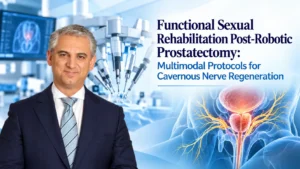
Functional Sexual Rehabilitation Post-Robotic Prostatectomy: Multimodal Protocols for Cavernous Nerve Regeneration
Preserving and restoring erectile function following radical prostatectomy remains one of the most critical aspects of post-surgical survivorship. While modern…
Read More →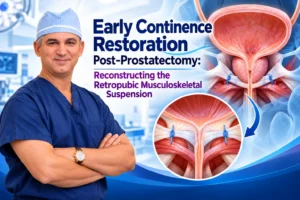
Early Continence Restoration Post-Prostatectomy: Reconstructing the Retropubic Musculoskeletal Suspension
Urinary continence is one of the most critical determinants of quality of life following radical prostatectomy. While oncologic cure remains…
Read More →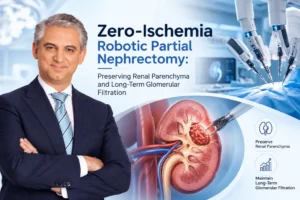
Zero-Ischemia Robotic Partial Nephrectomy: Preserving Renal Parenchyma and Long-Term Glomerular Filtration
The widespread use of multiphasic contrast-enhanced CT scans and abdominal MRIs has led to the routine detection of incidental small…
Read More →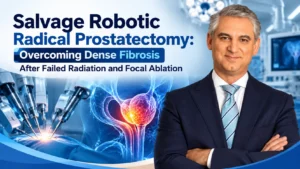
Salvage Robotic Radical Prostatectomy: Overcoming Dense Fibrosis After Failed Radiation and Focal Ablation
Primary radiation therapy—including external beam radiation therapy (EBRT), stereotactic body radiation therapy (SBRT), proton beam therapy, and brachytherapy (radioactive seed…
Read More →
The SMART (Samadi Modified Advanced Robotic Technique) Protocol: Precision Apical Dissection and Pelvic Nerve Preservation
Radical prostatectomy has long been recognized as a benchmark curative therapy for localized prostate cancer. However, the procedure historically confronted…
Read More →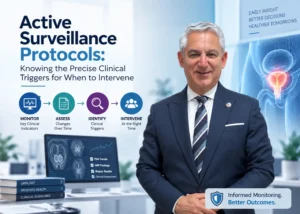
Active Surveillance Protocols: Knowing the Precise Clinical Triggers for When to Intervene
Receiving a prostate cancer diagnosis triggers an immediate reaction to seek prompt removal of the tumor. However, for a select…
Read More →
Familial and Genetic Risk in Men’s Health: When BRCA Mutations and Family History Demand Early Screening
For decades, genetic screening for BRCA1 and BRCA2 gene mutations was viewed almost exclusively through the lens of women’s health.…
Read More → 212-365-5000