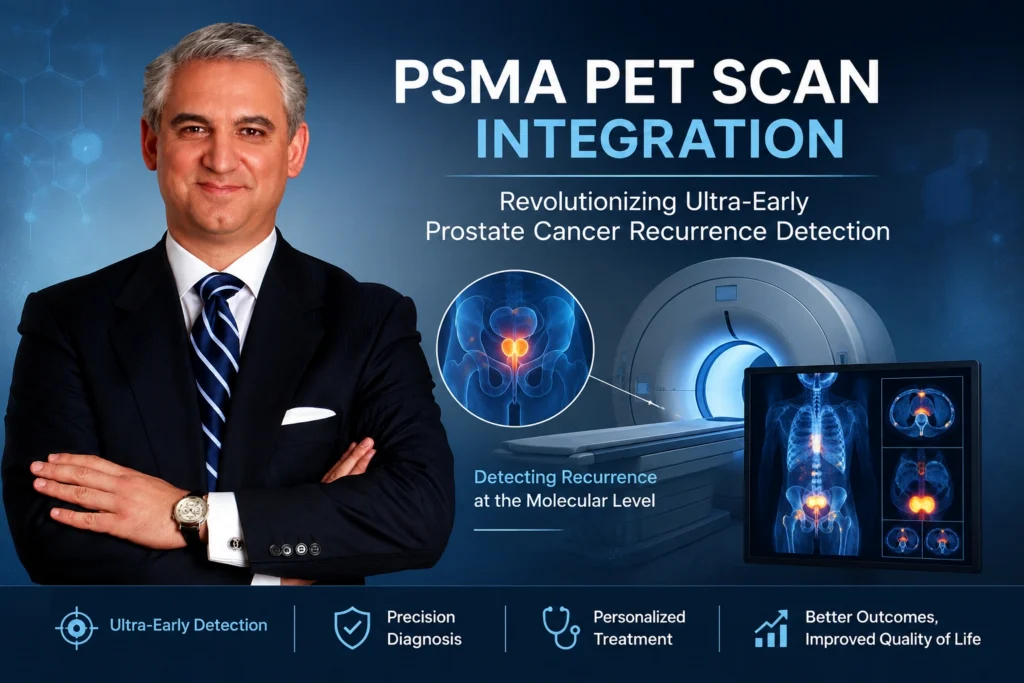
A rising Prostate-Specific Antigen (PSA) level following primary treatment—known clinically as biochemical recurrence—is a deeply anxious moment for any patient. Historically, when a man experienced a post-treatment PSA uptick, standard imaging technologies such as conventional CT scans, MRIs, and bone scans frequently failed to locate the source. Because conventional imaging requires a tumor to reach a significant size or cause structural bone changes to be detected, microscopic recurrences remain invisible, forcing clinicians to make educated guesses regarding secondary treatment strategies.
The integration of Prostate-Specific Membrane Antigen Positron Emission Tomography (PSMA PET) scanning has completely transformed this diagnostic landscape. By tracking prostate cancer at the molecular level, PSMA PET imaging detects recurrent lesions when PSA levels are extraordinarily low, enabling true ultra-early targeted intervention.
As Director of Men’s Health and Urologic Oncology at St. Francis Hospital & Heart Center in Roslyn, New York, Dr. David Samadi incorporates state-of-the-art PSMA PET diagnostics into his clinical protocol. Paired with his strict “Samadi Guarantee”—executing 100% of every surgical procedure personally—Dr. Samadi leverages precision imaging to distinguish between localized prostatic bed recurrences and distant micro-metastases, ensuring every patient receives an exact, personalized secondary treatment plan.
The Mechanism: How PSMA PET Imaging Pinpoints Cancer Cells
PSMA is a transmembrane glycoprotein that is overexpressed—often up to 1,000 times higher than normal—on the surface of approximately 95% of prostate cancer cells.
Unlike traditional CT scans that look purely at anatomical size or bone scans that measure bone turnover, PSMA PET is a functional molecular diagnostic:
- Targeted Radioactive Tracers: A specialized radiotracer (such as Gallium-68 PSMA-11 or Pylarify/Fluorine-18) is injected into the patient’s bloodstream.
- Lock-and-Key Binding: The tracer circulating in the blood binds specifically to the extracellular domain of PSMA proteins on malignant cells.
- High-Resolution Fusion Scanning: The PET scanner captures the concentrated radio-emissions, merging them with high-resolution CT or MRI images to highlight the exact location of malignant cells with sub-centimeter resolution.
[Biochemical Recurrence (PSA Rising)] ──► PSMA Radiotracer Injection
│
▼
[Lock-and-Key Binding to PSMA Proteins] ──► Molecular PET/CT Fusion Capture
│
▼
[Sub-Centimeter Localization] ──► Distinguishes Local Bed vs. Nodal vs. Bone Metastasis

Diagnostic Resolution: PSMA PET vs. Conventional Staging
The primary advantage of PSMA PET technology is its remarkable diagnostic sensitivity at ultra-low PSA concentrations. Traditional scans typically require a PSA level above 2.0 to 5.0 ng/mL to locate a tumor; PSMA PET imaging can identify recurrent lesions at PSA levels below 0.5 ng/mL.
| Feature / Performance Metric | Conventional CT & Bone Scans | Advanced PSMA PET/CT Fusion |
| Diagnostic Basis | Anatomical size change & bone reaction | Molecular receptor density (PSMA protein) |
| Sensitivity at PSA < 0.5 ng/mL | < 10% detection rate | 50% to 70%+ detection sensitivity |
| Sub-Centimeter Nodal Clearance | Misses normal-sized (<1 cm) malignant nodes | Identifies micro-metastases in small nodes |
| Atypical Site Detection | Limited evaluation of soft tissue | Detects retroperitoneal & visceral sites |
| Clinical Impact | High risk of non-targeted systemic treatment | Enables pinpoint targeted salvage therapy |
Clinical Impact: Transforming Post-Recurrence Management
Locating the precise anatomical origin of a rising PSA eliminates the diagnostic guesswork that previously complicated recurrence management. PSMA PET imaging fundamentally categorizes patients into clear therapeutic pathways:
- True Local Recurrence: If PSMA PET imaging demonstrates that the cancer is confined strictly to the surgical bed or remnant tissue, local salvage radiation therapy can be delivered with curative intent.
- Oligometastatic Disease: If the scan reveals only one to three isolated retroperitoneal or pelvic lymph nodes, stereotactic body radiation therapy (SBRT) or targeted surgical excision can be deployed to ablate the specific lesions without subjecting the patient to immediate, whole-body androgen deprivation therapy (ADT).
- Systemic / Polymetastatic Disease: If widespread micro-metastases are identified in the bones or soft tissue, patients can avoid ineffective localized radiation and immediately initiate optimized systemic therapy.
The Samadi Protocol Integration at St. Francis Hospital
At St. Francis Hospital in Roslyn, Dr. David Samadi combines advanced molecular imaging with decades of master-level surgical expertise. For primary cases, Dr. Samadi utilizes his proprietary SMART (Samadi Modified Advanced Robotic Technique) procedure—an inside-out, athermal approach that achieves maximum negative margin rates to minimize recurrence risk from the start.
For patients referred to the East Hills practice with biochemical recurrence following prior external treatments, PSMA PET imaging serves as the ultimate roadmap. By reviewing molecular PET scans directly, Dr. Samadi accurately evaluates candidate safety for complex salvage procedures, ensuring patients receive clear diagnostic guidance and personalized oncological care.
Conclusion
A rising PSA level after prostate cancer treatment demands rapid, high-precision diagnostics. By detecting micro-metastases and local recurrences long before they appear on conventional scans, PSMA PET imaging provides the clarity required to select the precise secondary treatment path. Through the Samadi Guarantee at St. Francis Hospital, men across Long Island and the greater New York area can access advanced urologic oncology designed to eliminate cancer while preserving long-term quality of life.
If you are experiencing a rising PSA or seeking an expert second opinion on post-treatment management, contact the Samadi Robotics Center today at 212-365-5000 to schedule a consultation at our East Hills office located at 2200 Northern Blvd., Suite 120, Roslyn, NY.
 212-365-5000