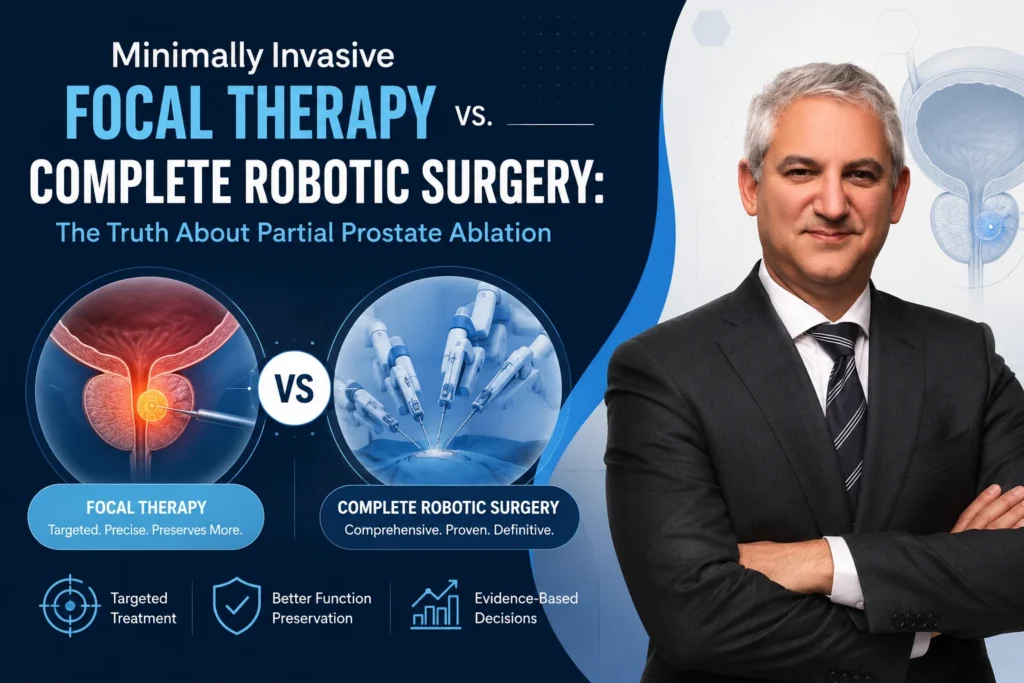
In recent years, “focal therapy”—which includes High-Intensity Focused Ultrasound (HIFU), cryotherapy, photodynamic therapy, and irreversible electroporation (NanoKnife)—has been widely marketed as a non-invasive “middle ground” for prostate cancer. Promising to ablate only the visible tumor while leaving the rest of the prostate gland intact, focal ablation appeals to men seeking to minimize treatment-related side effects like urinary incontinence and erectile dysfunction.
However, choosing focal therapy based on marketing claims rather than rigorous oncological data can lead to dangerous blind spots. While partial ablation may sound appealing, prostate cancer is biologically notorious for being a multifocal disease—meaning that invisible, microscopic cancer clusters frequently exist outside the primary focal target.
As Director of Men’s Health and Urologic Oncology at St. Francis Hospital & Heart Center in Roslyn, New York, Dr. David Samadi provides patients with straightforward, evidence-based guidance. Backed by his strict “Samadi Guarantee”—personally performing 100% of every robotic procedure—Dr. Samadi breaks down the true clinical limitations of partial ablation compared to the definitive cure and pathological peace of mind provided by complete robotic prostatectomy.
The Multifocal Reality of Prostate Cancer
The fundamental flaw of partial focal ablation lies in the unique biology of prostate tumors. Pathological analysis of radical prostatectomy specimens reveals that in over 80% of prostate cancer cases, the disease is multifocal.
[Biopsy & mpMRI] ──► Identifies 1 Primary “Index” Lesion (Focal Target)
│
▼
[Hidden Micro-Tumors] ──► 2 to 4 Secondary Lesions Missed by Imaging Across Gland
│
▼
[Focal Ablation Failure] ──► Primary lesion destroyed; un-ablated micro-tumors grow unchecked
- The Index Lesion Fallacy: Multiparametric MRI (mpMRI) excels at identifying the largest, most aggressive “index” tumor. However, mpMRI routinely misses microscopic, high-grade lesions scattered in other zones of the gland.
- Selective Destruction: Focal therapy destroys only the target area imaged on screen. Leaving 70% to 80% of untreated prostate tissue behind creates a fertile environment for secondary tumor growth.
- The Need for Ongoing Surveillance: Because the prostate gland remains in the body, men who undergo focal therapy are locked into endless rounds of repeat biopsies, rising PSA anxiety, and mandatory mpMRI scans to monitor for recurrence.
Comparative Analysis: Focal Ablation vs. Complete Robotic Surgery
| Diagnostic / Clinical Metric | Partial Focal Ablation (HIFU/Cryo) | Dr. Samadi Robotic Surgery (SMART) |
| Gland Removal | Partial tissue destruction; organ remains intact | Complete removal of entire prostate & nodes |
| Pathological Confirmation | Zero; relies on unverified image estimations | 100% true pathological staging & margin analysis |
| Multifocal Cancer Risk | Leaves secondary micro-tumors unaddressed | Completely eliminates all primary & secondary lesions |
| Post-Treatment Monitoring | High PSA volatility; requires repeat needle biopsies | PSA drops to zero (<0.01 ng/mL); definitive tracking |
| Secondary Salvage Options | Salvage surgery after focal ablation is highly complex | Radiation remains 100% available if ever needed |
The Pathological Advantage of Complete Surgical Removal
The single greatest clinical drawback of focal ablation is that it leaves the tumor inside the body, unexamined by a pathologist. Initial needle biopsies sample less than 1% of the total prostate gland. Up to 30% of standard needle biopsies under-stage the true Gleason aggressiveness of the cancer.
When Dr. David Samadi performs a robotic radical prostatectomy using his proprietary SMART (Samadi Modified Advanced Robotic Technique), the complete prostate gland and adjacent lymph nodes are extracted intact:
- Exact Gleason Scoring: Pathologists slice the entire organ to measure the exact grade and depth of every tumor cluster.
- Surgical Margin Verification: Verifies that zero cancer cells remain at the outer surgical boundaries.
- Lymph Node Mapping: Confirms complete negative nodal clearance, providing definitive cancer-free peace of mind.
Master-Level Precision: Matching Focal Functional Outcomes
The historical argument for focal therapy was avoiding the urinary incontinence and erectile dysfunction associated with outdated surgical techniques. However, in the hands of a master surgeon who has personally executed over 10,000 cases, complete surgical removal delivers exceptional functional recovery alongside permanent cure.
Dr. Samadi’s SMART procedure approaches the prostate from the “inside out,” utilizing athermal (heat-free) micro-dissection. By avoiding electrocautery near the neurovascular bundles and employing a clipless, suture-free Dorsal Vein Complex (DVC) protocol, Dr. Samadi protects the urinary sphincter and natural erectile nerves.
This technical discipline yields a 97% long-term continence rate and an 85% natural potency preservation rate in eligible candidates—matching or exceeding the functional profile of focal ablation while delivering a total oncological cure.
Conclusion
Prostate cancer demands a complete, definitive solution rather than partial measures. While partial focal ablation promises minimal initial impact, leaving un-ablated prostate tissue behind carries long-term risks of undetected disease progression. Through the Samadi Guarantee at St. Francis Hospital in Roslyn, men across Long Island and greater New York receive complete tumor elimination, true pathological clarity, and preserved daily quality of life.
Gain complete clarity on your prostate cancer diagnosis. Contact the Samadi Robotics Center today at 212-365-5000 to schedule an expert second opinion or consultation at our East Hills office located at 2200 Northern Blvd., Suite 120, Roslyn, NY.
 212-365-5000