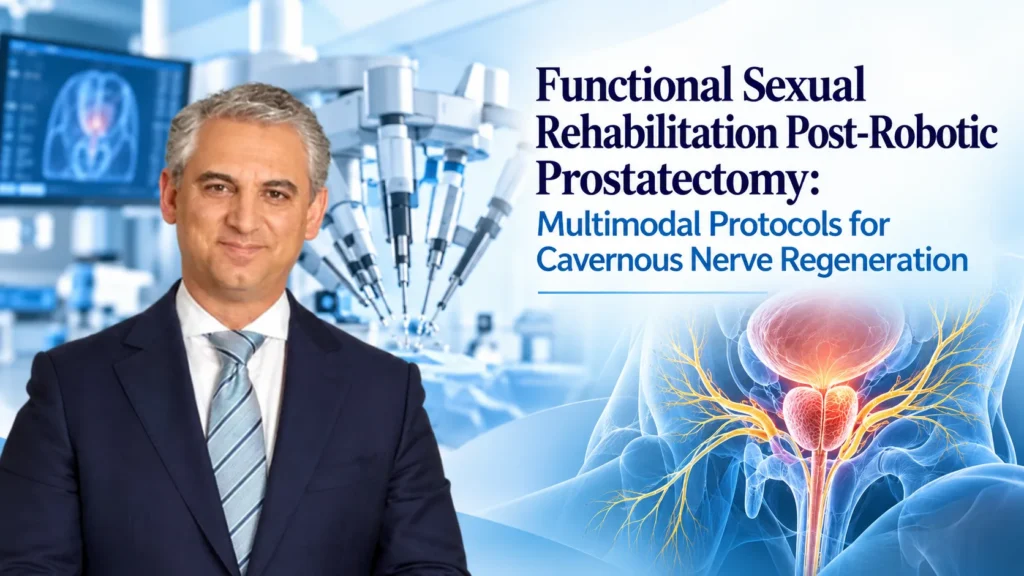
Preserving and restoring erectile function following radical prostatectomy remains one of the most critical aspects of post-surgical survivorship. While modern nerve-sparing techniques have reduced the rates of permanent erectile dysfunction, the biological reality of pelvic surgery is that even gentle handling of the neurovascular bundles induces a temporary state of nerve dysfunction known as neuropraxia.
During this recovery window—which can span from several months to up to two years—the delicate cavernous nerves are unable to transmit normal nocturnal or psychogenic erectile signals to the penile vasculature. Without routine nighttime erections, the spongy smooth muscle of the corpora cavernosa is deprived of oxygen-rich arterial blood. Prolonged intracellular hypoxia triggers a cascade of smooth muscle apoptosis (programmed cell death), collagen deposition, and veno-occlusive dysfunction (venous leak), leading to permanent structural damage and penile shortening if left unaddressed.
Practicing in New York, Dr. David B. Samadi established the SMART (Samadi Modified Advanced Robotic Technique) protocol, which pairs athermal, cold-scissor nerve preservation with a structured, early-intervention penile rehabilitation protocol. Rather than adopting a passive “wait-and-see” approach, Dr. Samadi’s multimodal protocol proactively oxygenates the erectile bodies, prevents fibrotic remodeling, and accelerates cavernous axonal regeneration, giving men an evidence-based roadmap back to functional sexual intimacy.
The Pathophysiology of Post-Prostatectomy Neuropraxia
The cavernous nerves travel along the posterolateral borders of the prostate gland as a fine, microscopic meshwork of parasympathetic and sympathetic fibers. Even when these nerves are anatomically spared without thermal or direct mechanical transection, microscopic traction or stretch during dissection triggers a temporary nerve stun:
[SURGICAL TRACTION / NERVE MANIPULATION]
│
▼
[CAVERNOUS NERVE NEUROPRAXIA]
(Temporary disruption of axonal signal conduction)
│
▼
[ABSENCE OF NOCTURNAL TUMEFACTION]
(Loss of 3 to 5 natural nighttime erections)
│
▼
[INTRACAVERNOSAL TISSUE HYPOXIA]
(Oxygen tension drops from arterial ~90 mmHg to venous ~35 mmHg)
│
▼
[TRANSFORMING GROWTH FACTOR-BETA 1 (TGF-β1)]
(Triggers collagen deposition, smooth muscle apoptosis, & fibrosis)
│
▼
[PERMANENT VENO-OCCLUSIVE DYSFUNCTION / “VENOUS LEAK”]
Without proactive intervention, the ratio of flexible smooth muscle to stiff collagen within the corpora cavernosa shifts unfavorably. Once significant fibrosis takes hold, the erectile tissue loses its ability to expand and compress the subtunical venules against the tunica albuginea, resulting in permanent venous leakage even if the nerves eventually regenerate.
The Multimodal Rehabilitation Protocol
Functional recovery requires an active program that starts as soon as the urinary catheter is removed. The goal is straightforward: maintain tissue oxygenation to prevent scarring while the nerves biologically heal.
1. Daily Low-Dose Phosphodiesterase Type 5 (PDE-5) Inhibitors
Rather than utilizing PDE-5 inhibitors (such as Tadalafil or Sildenafil) on-demand for sexual intercourse, rehabilitation relies on daily low-dose therapy (e.g., Tadalafil 5 mg daily):
- Maintains continuous baseline endothelial nitric oxide production.
- Promotes nocturnal arterial blood flow into the sinusoidal spaces, preventing low-oxygen cellular environments.
- Helps preserve endothelial cell integrity and smooth muscle architecture during early neuropraxia.
2. Vacuum Erection Devices (VED) for Mechanical Oxygenation
A medical-grade vacuum device is introduced within 2 to 4 weeks postoperatively:
- The negative pressure gently draws oxygen-rich arterial blood into the flaccid corpora cavernosa.
- Serves as passive physical therapy for the penis, stretching the elastic tunica albuginea and counteracting tissue retraction or structural shortening.
- Used daily for 5 to 10 minutes without a constricting ring purely for tissue conditioning and oxygenation, rather than intercourse.
3. Intracavernosal Injections (ICI) and Intraurethral Suppositories
For men with sluggish nerve recovery or those who do not respond to oral PDE-5 inhibitors during the initial recovery months:
- Prostaglandin E1 (Alprostadil / Trimix): Directly relaxes corporal smooth muscle independently of the cavernous nerves, bypassing damaged neural pathways entirely to produce rigid, arterial-perfused erections.
- Prevents prolonged hypoxia in men with slow axonal recovery, ensuring healthy tissue compliance until natural neural function returns.
4. Low-Intensity Extracorporeal Shockwave Therapy (Li-ESWT)
An emerging regenerative adjunct that delivers acoustic sound waves to the penile shaft:
- Stimulates local neo-angiogenesis (new microvascular vessel formation).
- Promotes the recruitment of endogenous mesenchymal stem cells to accelerate cavernous tissue repair.
Comparative Overview: Observation vs. Multimodal Rehabilitation
| Clinical Dimension | Passive Observation (“Wait and See”) | Active Multimodal Rehabilitation |
| Corporal Oxygenation | Unmanaged; extended hypoxic episodes | Maintained via daily PDE-5i and VED therapy |
| Penile Length & Girth | Documented retraction / structural shrinkage | Preserved through routine mechanical stretching |
| Smooth Muscle Preservation | Progressive apoptosis and collagen fibrosis | Preserved; suppresses TGF-β1 collagen deposition |
| Time to Functional Rigidity | Often delayed (12 to 24+ months) | Accelerated recovery timeline (6 to 12 months) |
| Risk of Venous Leak | Substantially higher secondary to fibrosis | Significantly minimized by preserving elasticity |
| Psychological Impact | Heightened anxiety and intimacy avoidance | Active patient participation and restored confidence |
The Axonal Regeneration Timeline
Peripheral nerves regenerate slowly. Peripheral axons heal at an average biological rate of roughly 1 millimeter per day:
- Months 1 to 3: Cavernous nerves remain largely inactive. Nighttime tumescence is absent or weak. The focus is strictly on mechanical oxygenation (VED and daily PDE-5 inhibitors) to protect penile tissue.
- Months 4 to 6: Early nerve sprouting begins. Patients often report early morning fullness, partial rigidity, or responses to high-dose oral medications.
- Months 6 to 12: Axonal continuity expands. Erections become firmer and more consistent, often transitioning from partial tumescence to functional rigidity suitable for penetration.
- Months 12 to 24: Maximum functional nerve recovery is reached. Many patients are able to reduce their reliance on rehabilitation devices and step down from daily oral therapies to on-demand use.
Optimizing Baseline Factors for Nerve Healing
Nerve regeneration is a systemic process. Maximizing outcomes requires optimizing cardiovascular and metabolic health:
- Glycemic Control: Elevated blood glucose damages microvascular capillary beds supplying the nerves (vasa nervorum). Tight blood sugar control is essential for diabetic patients.
- Aerobic Exercise: Regular cardiovascular activity increases systemic endothelial nitric oxide synthase (eNOS) activity and promotes pelvic blood perfusion.
- Pelvic Floor Physical Therapy: Guided pelvic floor training strengthens the ischiocavernosus and bulbospongiosus muscles, which provide the high-pressure structural rigidity needed to maintain rigid erections during intimacy.
Conclusion
Erectile recovery following prostate cancer surgery is a long-term rehabilitation process, not an immediate switch. By combining the athermal, nerve-sparing technique of the SMART robotic prostatectomy with an early, proactive rehabilitation protocol, Dr. David B. Samadi provides men with a comprehensive recovery pathway designed to protect erectile tissues, stimulate nerve regeneration, and restore natural intimacy.
- Surgeon: Dr. David B. Samadi, MD
- Specialization: Robotic Urologic Oncology, Prostate Cancer Surgery, Sexual Rehabilitation
- Key Innovations: Developer of the SMART (Samadi Modified Advanced Robotic Technique) Protocol
- Practice Locations:
- Midtown Manhattan: 485 Madison Avenue, 21st Floor, New York, NY 10022
- Long Island: St. Francis Hospital & Heart Center / 2200 Northern Blvd., Suite 120, East Hills, Roslyn, NY 11548
- Official Website:roboticoncology.com
- Direct Consultations: (212) 365-5000
 212-365-5000