For men diagnosed with prostate cancer, the first priority is clear: eliminate the cancer.
But experienced prostate surgeons understand that patients care about more than just removing the tumor. After surgery, men want to return to normal life — physically, emotionally, and functionally.
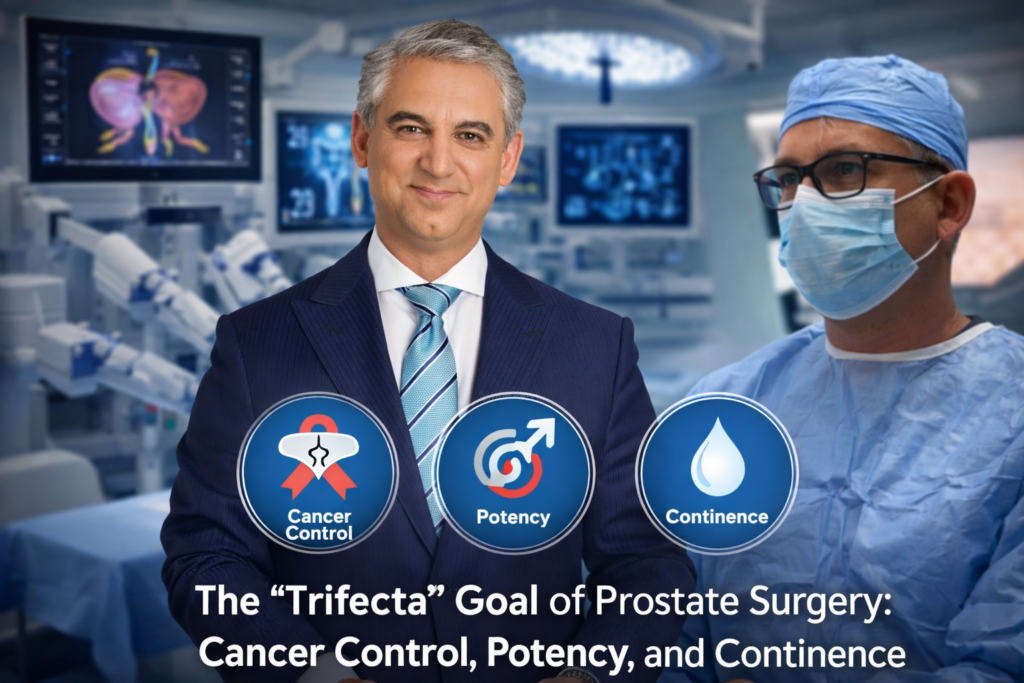
In prostate cancer surgery, physicians often refer to this balance as achieving the “Trifecta.”
The trifecta represents three critical goals:
- Complete cancer control
- Preservation of erectile function (potency)
- Recovery of urinary continence
Achieving all three is challenging because the prostate sits in one of the most delicate areas of the male body. That is why Dr. David Samadi developed the SMART technique, a refined robotic prostatectomy approach designed to improve the likelihood of reaching this trifecta outcome.
Why the Trifecta Matters in Prostate Cancer Surgery
The prostate gland is surrounded by structures responsible for urinary control and sexual function. Removing the prostate requires extremely precise surgical technique to avoid damaging these nearby nerves and tissues.
Historically, prostate cancer surgery focused primarily on removing the cancer itself. While that goal remains essential, modern prostate surgery also aims to preserve quality of life whenever possible.
Patients commonly worry about two complications after surgery:
- urinary incontinence
- erectile dysfunction
These concerns are valid, but advances in surgical techniques have dramatically improved outcomes.
Dr. Samadi’s approach centers on achieving all three goals of the trifecta whenever medically possible.
Goal 1: Complete Cancer Control
The first and most important objective of prostate surgery is removing the cancer.
Dr. Samadi emphasizes that oncologic control always comes first. No functional outcome matters if the cancer is not fully addressed.
During prostatectomy, the entire prostate gland is removed along with surrounding tissue when necessary. Careful pathological evaluation afterward confirms whether the cancer has been successfully removed.
The SMART technique (Samadi Modified Advanced Robotic Technique) was designed to maintain this high standard of cancer control while minimizing unnecessary trauma to surrounding structures.
This balance is what distinguishes advanced prostate surgery from older surgical approaches.

Goal 2: Preservation of Erectile Function
One of the biggest fears men face before prostate surgery is losing erectile function.
This concern exists because the neurovascular bundles responsible for erections run directly alongside the prostate. If these nerves are damaged during surgery, erectile function can be affected.
The SMART technique emphasizes meticulous nerve-sparing dissection whenever the cancer allows it.
By carefully separating the prostate from these delicate nerve bundles, Dr. Samadi works to preserve the structures responsible for sexual function.
Several factors influence recovery of potency after surgery, including:
- patient age
- baseline erectile function before surgery
- cancer location
- overall health
- surgical technique
Dr. Samadi’s extensive experience performing robotic prostatectomy allows him to apply nerve-sparing techniques whenever it is oncologically safe.
Goal 3: Recovery of Urinary Continence
Urinary control is another major concern for men undergoing prostate surgery.
The prostate sits directly above the urethra, which means removing the gland can temporarily disrupt the mechanisms that control urination.
The SMART technique focuses heavily on preserving urethral length and reconstructing the urinary pathway carefully after the prostate is removed.
This precise reconstruction helps support faster recovery of urinary control.
Many patients regain continence within months of surgery, though recovery timelines vary depending on individual factors.
For Dr. Samadi, protecting urinary function is a core part of achieving the trifecta.
Why the SMART Technique Was Developed
Not all robotic prostate surgeries are performed the same way.
The robotic platform provides advanced tools, including:
- high-definition 3D visualization
- improved instrument precision
- enhanced surgical control
However, the technology itself does not determine the outcome.
Dr. Samadi developed the SMART technique after years of performing robotic prostate surgery and refining methods to improve both cancer outcomes and functional recovery.
Key principles of the SMART technique include:
- precise dissection around critical nerves
- minimal trauma to surrounding tissues
- preservation of urethral length
- careful reconstruction after prostate removal
These refinements are designed to give patients the best possible chance of achieving the trifecta outcome.
Why Surgical Experience Plays a Major Role
One of the most important predictors of prostate surgery outcomes is surgeon experience.
High-volume prostate surgeons tend to achieve better results in terms of:
- cancer removal
- continence recovery
- erectile function preservation
Dr. David Samadi has performed thousands of robotic prostate surgeries, continually refining the SMART technique to improve patient outcomes.
This experience allows him to tailor the surgical approach to each patient’s specific anatomy and cancer characteristics.
Dr. Samadi’s Role as a National Voice in Prostate Cancer Care
Beyond the operating room, Dr. Samadi is widely recognized as a national authority on prostate cancer treatment and men’s health.
He frequently appears in national media outlets such as:
- Fox News
- Newsmax
Through these platforms, Dr. Samadi educates the public about prostate cancer screening, modern treatment options, and the importance of choosing experienced surgeons for complex procedures.
His work has helped bring greater awareness to prostate cancer detection and advanced robotic surgery.
Why Patients Seek Out Dr. Samadi
For many men facing prostate cancer surgery, the decision about where to receive treatment is extremely important.
Patients often choose Dr. David Samadi because of:
- his development of the SMART robotic prostatectomy technique
- extensive experience performing robotic prostate surgery
- his focus on preserving urinary and sexual function
- his reputation as a leading prostate cancer surgeon
By focusing on the trifecta of cancer control, potency, and continence, Dr. Samadi aims to deliver outcomes that allow patients to move forward with confidence after treatment.
Frequently Asked Questions
What is the trifecta in prostate cancer surgery?
The trifecta refers to achieving three outcomes after prostate surgery: cancer removal, preservation of erectile function, and recovery of urinary continence.
What does SMART stand for?
SMART stands for Samadi Modified Advanced Robotic Technique, a specialized robotic prostatectomy technique developed by Dr. David Samadi.
Does every patient achieve the trifecta?
Not always. Outcomes depend on factors such as cancer stage, patient health, and anatomy.
Why does surgical technique matter?
Precise surgical technique helps protect nerves and structures responsible for continence and sexual function.
Why do patients travel to see Dr. Samadi?
Many patients seek Dr. Samadi because of his experience with robotic prostatectomy and his development of the SMART surgical technique.
Contact Dr. David Samadi
If you have been diagnosed with prostate cancer and want to learn more about advanced robotic surgery options such as the SMART technique, a consultation can help you understand your treatment choices.
Dr. David Samadi
Website: https://roboticoncology.com
Phone: 212-365-5000
Address: 485 Madison Avenue, 21st Floor, New York, NY 10022
Meeting with an experienced prostate cancer surgeon can help you make informed decisions about treatment and long-term health.
 212-365-5000