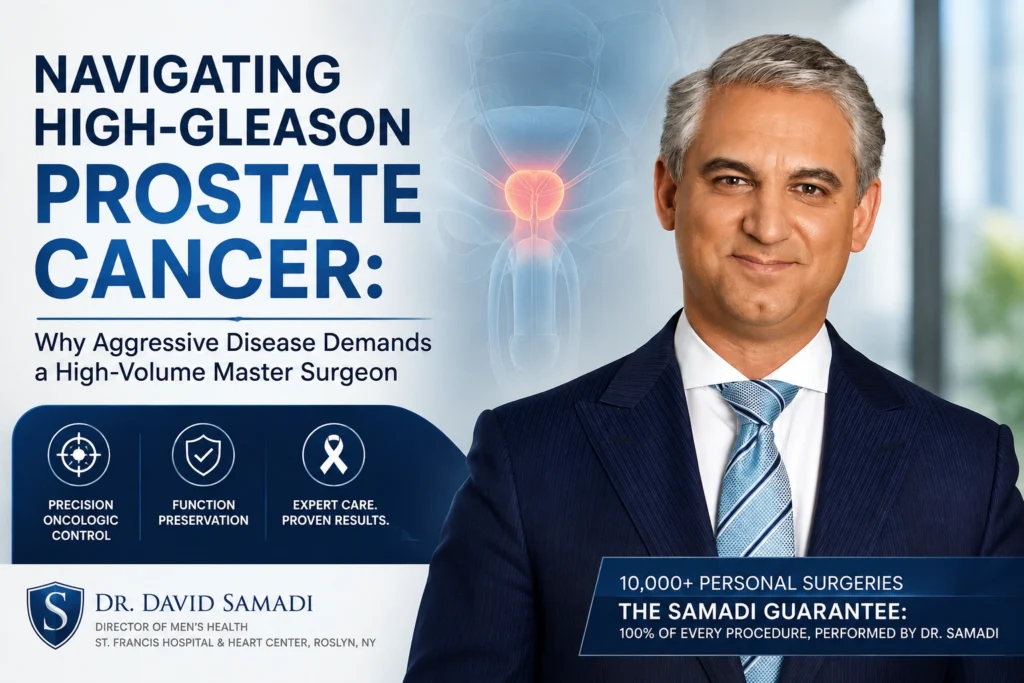
Receiving a prostate cancer diagnosis is daunting, but learning that your pathology report shows a High-Gleason score (Gleason 8, 9, or 10) elevates the situation to an urgent medical priority. High-grade prostate cancer indicates that the malignant cells are poorly differentiated, aggressive, and possess a high propensity for rapid growth and early metastasis beyond the prostatic capsule.
When confronting high-risk disease, the margin for surgical error drops to zero. Operating on aggressive tumors requires a delicate balance: achieving complete oncological clearance by eliminating every trace of cancer while meticulously preserving the delicate pelvic structures responsible for urinary control and sexual potency.
As Director of Men’s Health at St. Francis Hospital & Heart Center in Roslyn, New York, Dr. David Samadi brings a personal track record of over 10,000 successful robotic surgeries directly to Long Island. Through his strict “Samadi Guarantee”—executing 100% of every procedure personally—he provides men with high-grade disease the master-level surgical discipline required to conquer aggressive prostate cancer.
Understanding the Anatomy of High-Gleason Tumors
A Gleason score is determined by analyzing the microscopic architecture of prostate tissue obtained during a biopsy. High-Gleason scores (Grade Groups 4 and 5) signify that the tumor architecture is highly irregular.
Because high-grade tumors grow rapidly, they frequently exhibit complex anatomical challenges:
- Extracapsular Extension (ECE): High-grade cancer cells are far more likely to push through the outer fibrous capsule of the prostate, threatening adjacent tissues.
- Seminal Vesicle Invasion (SVI): Aggressive cells often migrate into the nearby seminal vesicles, requiring extended anatomical resection.
- Microscopic Lymph Node Metastasis: High-Gleason tumors carry an elevated risk of spreading to the regional pelvic lymph nodes, necessitating a comprehensive pelvic lymph node dissection (PLND).
In low-volume surgical hands, operating on high-Gleason cancer often leads to “positive surgical margins”—leaving microscopic cancer cells behind—or forces the surgeon to perform an overly aggressive wide excision that unnecessarily destroys the surrounding nerve beds.
The “Volume-Outcome” Imperative in High-Risk Oncology
Clinical studies consistently prove that surgical volume directly dictates patient outcomes in complex oncological procedures. In high-risk prostate cancer cases, the experience of the console operator is the single most critical factor in achieving clean surgical margins.
[Low-Volume Surgeon] ──> Higher risk of positive margins ──> Mandatory secondary radiation/hormones
VS.
[Dr. David Samadi] ──> 10,000+ personal cases ──> High negative margin rate & functional preservation
An experienced master surgeon brings distinct advantages to high-Gleason operations:
- Anatomical Intuition: Decades of console experience allow Dr. Samadi to feel and see subtle tissue density changes, accurately identifying the precise plane between tumor-bearing tissue and healthy pelvic structures.
- Extended Pelvic Lymph Node Dissection: For high-risk disease, Dr. Samadi performs a meticulous, extended lymph node clearance, removing key nodal basins to accurately stage the disease and eliminate micro-metastases without injuring adjacent iliac blood vessels.
- Customized Nerve Sparing: Even in high-Gleason cases, an expert hand can often achieve a safe, wide excision on the side of the tumor while safely sparing the neurovascular bundle on the unaffected side, protecting baseline potency.
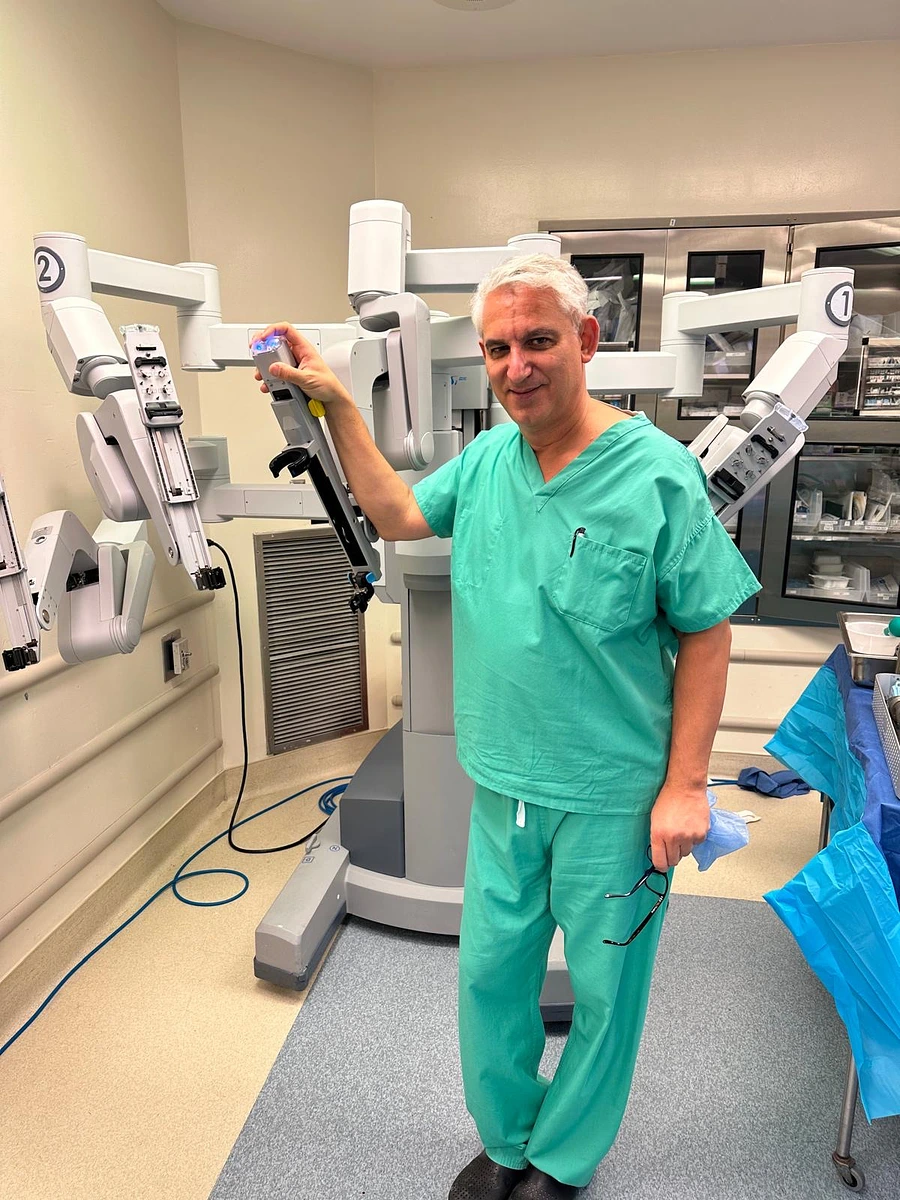
The SMART Technique Advantage for High-Risk Disease
Dr. David Samadi’s proprietary SMART (Samadi Modified Advanced Robotic Technique) procedure approaches the prostate from the “inside out.” This technical modification is particularly advantageous when navigating aggressive malignancies:
Athermal Dissection Prevents Tissue Trauma
Traditional robotic surgeries rely on electrocautery (electrical heat) to dissect blood vessels, creating “thermal spread” that shocks surrounding nerves and distorts tissue planes. Dr. Samadi utilizes athermal (completely heat-free) cold micro-instruments, keeping the surgical field visually pristine and preventing thermal injury to adjacent healthy tissues.
Clipless & Suture-Free DVC Protocol
Managing blood flow around high-risk tumors without obscuring the surgical field is paramount. Dr. Samadi’s clipless Dorsal Vein Complex (DVC) protocol controls bleeding without placing bulky metal clips or heavy compressive sutures near the urinary sphincter. This maintains visual clarity and protects the functional urethral length, yielding a 97% long-term continence rate even in complex resections.
Comparative Impact: Standard Care vs. The Samadi High-Risk Protocol
| Clinical Metric | Standard Institutional Hospital | Dr. David Samadi (St. Francis Hospital) |
| Primary Surgeon | Often delegated to residents in training | 100% Dr. David Samadi personally |
| Margin Safety Risk | Variable; increased risk of positive margins | Meticulous dissection targeting clean margins |
| Lymph Node Protocol | Basic or limited sampling | Comprehensive, extended pelvic lymph node clearance |
| Surgical Duration | Typically 3 to 5 hours for high-risk cases | Consistently completed in under 90 minutes |
| Recovery Profile | Extended hospital stay & high blood loss | 99% discharged within 24 hours; near-zero transfusion rate |
Multimodal Therapy: Surgery as the Anchor of Cure
For men with high-Gleason scores, radical prostatectomy serves as the foundational anchor of a comprehensive treatment strategy. Completely removing the primary tumor burden provides three pivotal clinical benefits:
- Definitive Pathological Staging: Obtains true Gleason grading and precise lymph node mapping, eliminating diagnostic guesswork.
- Elimination of the Primary Source: Prevents the main tumor from seeding further metastases throughout the body.
- Optimized Secondary Therapy: If post-surgical PSA monitoring indicates the need for adjuvant radiation or hormone therapy, treating a micro-recurrent disease in an empty prostatic bed is vastly more effective than radiating an intact, highly aggressive bulk tumor.
Conclusion
A high-Gleason prostate cancer diagnosis demands immediate, decisive action led by proven surgical expertise. Through the Samadi Guarantee at St. Francis Hospital in Roslyn, men on Long Island facing aggressive disease do not have to settle for institutional teaching models or fragmented care. By putting your recovery in the hands of a master surgeon who has performed over 10,000 personal procedures, you gain the absolute highest chance of defeating high-risk cancer while protecting your long-term daily independence.
Contact the Samadi Robotics Center today at 212-365-5000 to schedule an urgent, confidential consultation or expert second opinion at our East Hills office located at 2200 Northern Blvd., Suite 120, Roslyn, NY.
 212-365-5000